Land is the most expensive input in any subdivision. Every square metre allocated to stormwater treatment is a square metre that isn't a section, a driveway, or open space — which is exactly why compact biofiltration has become such a critical tool for New Zealand developers.
But not all biofiltration is created equal, and choosing the wrong approach can mean giving up more land than necessary, taking on avoidable maintenance costs, or ending up with a system that underperforms once it's actually in the ground. Here's what to look for.
- Footprint vs. Treatment Performance
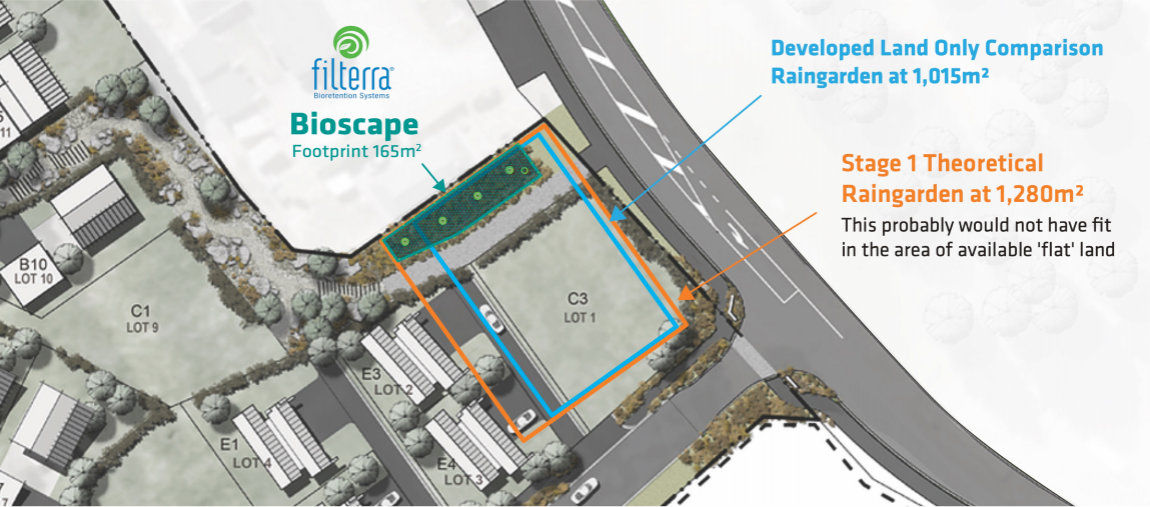
Conventional rain gardens need a lot of surface area to hit their treatment targets — often more than developers can justify giving up on a subdivision. Compact biofiltration systems like Filterra® are engineered to deliver the same water quality outcomes (TSS, heavy metals, nutrients, hydrocarbons) in a fraction of the space, because the engineered filter media and tree-box format concentrate the treatment process rather than relying on a large surface area to do the work.
What to check: Ask for the treatment area required per unit of contributing catchment, and compare it directly against a conventional raingarden sized for the same site. The gap is usually larger than expected.
2. Whole-of-Life Cost, Not Just Capital Cost
The upfront cost of a device is only part of the equation — and for developers handing assets over to council, it's often not even the most important part. Compact biofiltration systems are typically engineered for lower ongoing maintenance than a conventional raingarden treating the same catchment, since the contained media bed and defined access points make inspection and servicing far more straightforward than maintaining a large, open landscaped area.
What to check: Ask for maintenance cost comparisons over a realistic asset life (10+ years), not just the price of supply and install.
3. Scalability Across Catchment Sizes
Subdivisions rarely have one uniform catchment — different stages, different lot sizes, different road layouts. A biofiltration solution needs to scale from a single streetscape tree pit up to a large, shared catchment without losing treatment performance or blowing out the footprint required.
What to check: Whether the same underlying technology can be specified across your full range of catchment sizes, or whether you'll need to switch approaches (and suppliers) partway through a project.
4. Ease of Handover to Council
Most subdivision stormwater assets are eventually vested in council. A device that's difficult to inspect, maintain, or source parts for becomes council's problem — and can create friction during the vesting and consenting process. Systems designed with straightforward, accessible maintenance from day one tends to move through council handover more smoothly.
What to check: Whether the supplier provides maintenance training, ongoing support, or an established relationship with local councils already familiar with the system.
5. Proven Local Performance
New Zealand's climate, soils, and regulatory environment aren't the same as offshore markets. A device with a strong track record overseas still needs to prove itself here — established plantings, functioning media, and consistent performance across seasons.
What to check: Ask for local New Zealand installations and how they've performed since establishment, not just international case studies.
Two Options, One Technology Platform
For New Zealand developers, Filterra® and Filterra® Bioscape® offer two ways to apply the same proven biofiltration technology, depending on the scale of the site:
- Filterra® — a compact, tree-box-format system suited to streetscapes, car parks, and smaller catchments where footprint is at an absolute premium.
- Filterra® Bioscape® — a scaled, large-format application of the same technology, engineered for larger or more complex catchments where a bigger footprint is available, but a conventional rain garden or wetland still isn't the most land- or cost-efficient answer.
Both are backed by the same engineered media, biological treatment process, and 30 years of Stormwater360 experience delivering compact treatment solutions across New Zealand.
The Bottom Line
For developers weighing up stormwater treatment options on a subdivision, the real comparison isn't "biofiltration vs. no biofiltration" — it's compact, engineered biofiltration vs. a conventional raingarden that costs more in land now and more in maintenance later. Getting this decision right at concept design stage can free up saleable land, reduce long-term maintenance liability, and make council handover considerably easier.
Learn more about Filterra® and Filterra® Bioscape®